Modernizing Legacy BIG-IP Deployments: A Practical Roadmap for Enterprise Transformation
Enterprise applications have evolved dramatically over the last decade. They have moved from traditional data centers to hybrid and multi-cloud environments, embraced containers and Kubernetes, exposed hundreds of APIs, and introduced AI-powered services. Yet many organizations continue to rely on legacy F5 BIG-IP platforms that were originally designed for a very different era.
While these deployments often remain stable and reliable, stability alone is no longer enough. Aging hardware, manual operations, increasing security threats, and modern application architectures are exposing the limitations of legacy environments.
Modernizing a BIG-IP deployment is not simply about replacing hardware. It is about creating a more secure, automated, scalable, and cloud-ready application delivery platform.
Why Legacy BIG-IP Environments Become a Challenge
Many enterprises still operate BIG-IP appliances that have been in production for years. These platforms often support hundreds of applications and are deeply integrated into business-critical services.
However, organizations typically begin experiencing several common challenges:
- End-of-life hardware and increasing support costs
- Manual configuration processes and operational complexity
- Growing SSL/TLS processing requirements
- Limited automation capabilities
- Difficulty supporting hybrid and multi-cloud architectures
- Increasing application and API security risks
Although these systems continue to function, they often consume significant engineering resources simply to maintain operational stability.
The Business Drivers for Modernization
Modernization is usually driven by business requirements rather than technology alone.
Organizations today expect their infrastructure to provide:
- Faster application delivery
- Improved security posture
- Higher availability and resilience
- Simplified operations
- Better visibility and monitoring
- Infrastructure automation
- Reduced operational overhead
A modern BIG-IP environment becomes an enabler for digital transformation instead of a platform that slows it down.
What Does Modernization Actually Mean?
Modernization is not simply replacing old appliances with new hardware. It requires evaluating the entire application delivery architecture.
A modernization strategy may include:
- Migration to modern platforms such as F5 rSeries and VELOS
- Reviewing existing application delivery design
- Optimizing F5 LTM, Advanced WAF, DNS, APM, and AFM configurations
- Introducing Infrastructure as Code using AS3, Declarative Onboarding, and Terraform
- Improving observability through telemetry and centralized logging
- Preparing workloads for hybrid and multi-cloud deployments
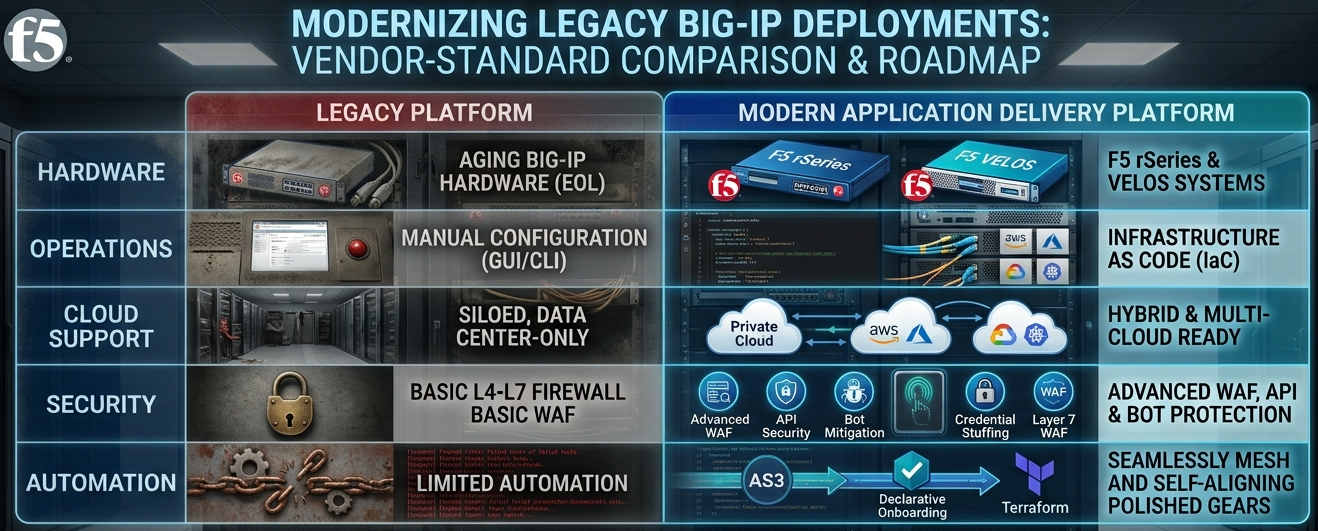
The goal is not only new infrastructure, but a more flexible and resilient platform.
The Role of Automation
One of the biggest differences between legacy and modern BIG-IP environments is automation.
Traditional deployments often rely on manual changes through GUI or CLI, increasing the possibility of configuration errors.
Modern environments use declarative configuration, version control, and automated deployment pipelines.
Automation helps organizations achieve:
- Consistent configurations
- Faster deployments
- Reduced human error
- Improved compliance
- Simplified disaster recovery
BIG-IP becomes a programmable infrastructure component rather than just a standalone appliance.
Security Must Also Evolve
The modern threat landscape is significantly different from when many BIG-IP environments were originally deployed.
Organizations now need protection against:
- API attacks
- Credential stuffing
- Bot attacks
- Account takeover
- Advanced Layer 7 threats
Modernization provides an opportunity to review security architecture, optimize F5 Advanced WAF policies, strengthen TLS security, and improve application visibility.
Planning a Successful Migration
Successful modernization starts with a detailed assessment of the existing environment.
Key assessment areas include:
- BIG-IP hardware and software versions
- Virtual servers, pools, and nodes
- SSL certificates
- iRules and custom configurations
- DNS and traffic management design
- Authentication integrations
- High Availability architecture
- Security policies
A structured assessment allows organizations to create a phased migration approach while minimizing business impact.
Common Migration Mistakes
Many organizations face challenges because modernization is treated as a simple hardware replacement.
Common mistakes include:
- Migrating unnecessary legacy configurations
- Ignoring technical debt
- Failing to review existing iRules
- Skipping application testing
- Not planning rollback procedures
- Missing opportunities for automation improvements
A successful modernization project should simplify the environment, not recreate old complexity on new platforms.
Looking Beyond the Data Center
Modern application delivery extends beyond traditional data centers.
Organizations increasingly operate across:
- Private data centers
- AWS, Azure, and Google Cloud
- Kubernetes platforms
- SaaS environments
A modern BIG-IP strategy should provide consistent application delivery, security, and visibility across these environments.
Measuring Success
A successful BIG-IP modernization delivers measurable improvements:
- Improved application availability
- Faster deployment cycles
- Reduced operational complexity
- Enhanced security capabilities
- Greater automation and visibility
- Improved scalability
These improvements create long-term value for both IT teams and the business.
Final Thoughts
Legacy F5 BIG-IP platforms have supported enterprise applications for many years and continue to provide strong reliability. However, modern application architectures, cloud adoption, and evolving security requirements demand a more flexible approach.
Modernizing BIG-IP is not simply about replacing technology. It is about building a secure, automated, and scalable application delivery platform that can support the next generation of enterprise applications.
Organizations that modernize strategically will be better positioned for cloud adoption, API-driven services, AI workloads, and future digital transformation.