Next Generation Firewall (NGFW) Managed Security Service
Modern enterprise networks have quietly stopped resembling “networks” in the traditional sense. There is no clear perimeter anymore, no simple inside or outside. Everything is distributed across cloud platforms, SaaS applications, remote users, APIs, and hybrid infrastructures that constantly shift under load and demand. In this environment, the role of a firewall has fundamentally changed. It is no longer just a traffic filter; it is a continuous security enforcement layer that must understand context, behavior, identity, and risk in real time.
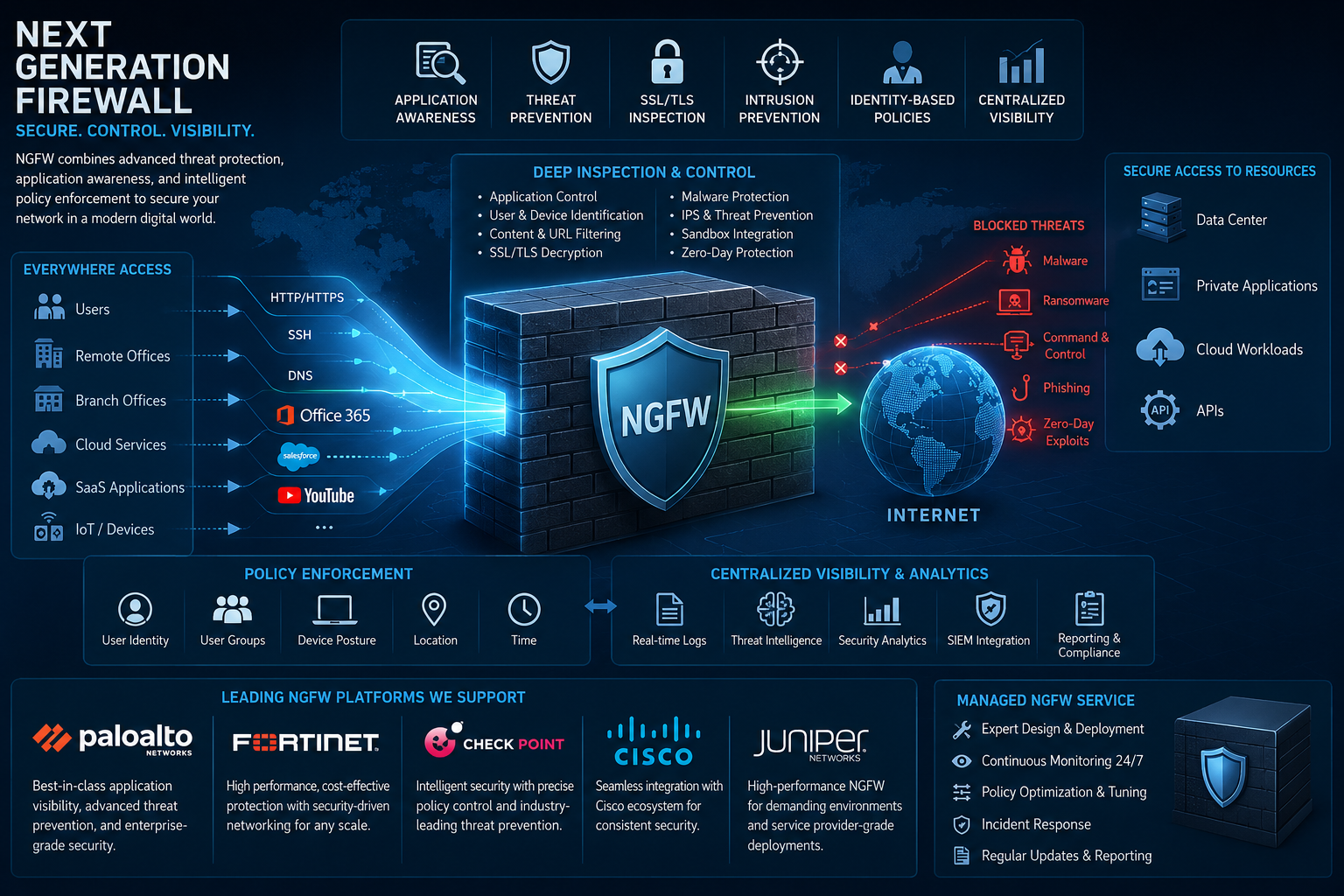
The NGFW service delivered by safenet.au is designed around this reality. Instead of treating firewalling as a static appliance configuration task, it is operated as a managed security function that adapts to application behavior and evolving threat landscapes. The focus is on visibility across encrypted and unencrypted traffic, consistent policy enforcement across environments, and the ability to detect and block modern attack patterns before they escalate into incidents.
At the core of this approach is deep application awareness combined with intrusion prevention and advanced threat inspection capabilities. Traffic is not only filtered based on ports or IP ranges but is analyzed in terms of actual application behavior, user identity, and session context. This becomes especially critical in environments where encrypted traffic dominates, because without proper inspection, most security controls are effectively blind. The service therefore includes controlled SSL/TLS decryption and inspection where appropriate, balancing security visibility, performance, and privacy considerations.
Threat prevention is not treated as a single feature but as an integrated capability spanning signature-based detection, behavioral analysis, and threat intelligence feeds. This allows the system to respond not only to known attack patterns but also to suspicious activity that deviates from expected baselines. Malware delivery attempts, command-and-control communication, and exploit techniques are continuously evaluated within the traffic flow, rather than being detected only after the fact.
A key design principle of the service is identity-driven policy enforcement. Instead of relying purely on network topology, policies are aligned with users, devices, and business roles. This reflects how modern access actually works, especially in hybrid and remote-first environments. Security decisions become contextual rather than static, reducing unnecessary exposure while maintaining operational flexibility for legitimate business activity.
The service is built to integrate into existing enterprise ecosystems rather than replacing them. Whether environments are heavily invested in Palo Alto Networks, Fortinet, Check Point Software Technologies, Cisco, or Juniper Networks infrastructures, the goal is to align the security architecture with the strengths of each platform while maintaining consistent operational visibility and policy intent across them. Each of these ecosystems brings different advantages, from deep application intelligence and advanced threat prevention, to high-performance throughput, mature policy control frameworks, and strong network integration capabilities. The managed service approach focuses on leveraging these strengths rather than forcing a one-size-fits-all model.
Beyond enforcement, the operational aspect of NGFW is equally critical. Continuous monitoring, log correlation, and security analytics integration ensure that security events are not isolated signals but part of a broader narrative of network behavior. This enables faster incident response and more accurate detection of anomalies that would otherwise be lost in traffic noise.
Ultimately, the purpose of this NGFW service is not to create the illusion of security through perimeter control, but to establish a continuously adaptive security enforcement layer that understands modern application behavior, enforces context-aware policies, and reduces the gap between detection and response. In a world where attack surfaces expand faster than traditional security models can adapt, this approach is no longer optional—it is a baseline requirement for operational resilience.